
A Living Workbook
When it comes to understanding a textbook, one must look beyond its content and evaluate it not as a book, but as a text technology. According to Professors Elaine Treharne and Claude Willan, text technologies are simply texts with a core triad of traits: intentionality, materiality, and functionality with an added element of cultural value ascribed to the text.[25] Intentionality looks at the human agency behind a text’s creation, materiality with the physical production and use of the text, and functionality, or the content and purpose the text itself serves. The cultural value is entirely dependent on the time, producer, and location of production of the text. It is the cultural value implicit in the text or placed onto the text.
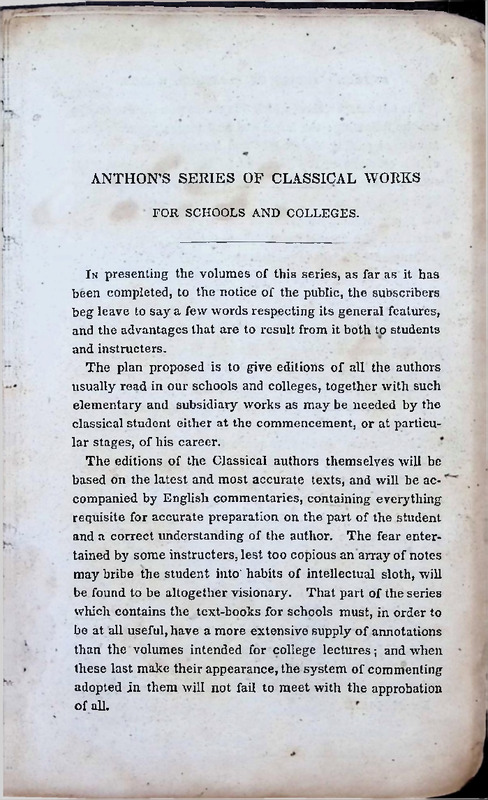
The intention of First Latin Lessons can be in part derived from an introduction to the series by the publisher and the table of contents of the work itself. Within the introduction, the publisher states that it is their intention to “give editions of all the authors usually read in our schools and colleges, together with such elementary and subsidiary works as may be needed by the classical student either at the commencement, or at particular stages, of his career.”[26] The goal of the broader series is to provide every needed tool for the classical student: from grammar guides to texts to translate and read. This work, First Latin Lessons, intends to provide the foundation of grammar and vocabulary so that later readings and translations may be possible.
Materiality is the most important part when evaluating a language textbook. The text itself is comprised primarily of paper, with a cloth binding. The text itself is in poor condition. The front and back cover, as well as the spine, has undergone severe deterioration. The spine itself has partially detached from the book’s signatures, forcing careful handling to prevent further deterioration. The edges of the pages have undergone significant wear and tear, no longer falling flush with each other. There are numerous tears and creases found throughout the text: ones found on page eleven, page one hundred and five, and page one hundred and seventy seven are quite extensive.
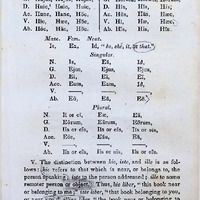
Beyond the physical condition of the book itself, what is more remarkable are the abundance of scribbles, scrawls, ink blots, and markings found throughout the work. Multiple inkblots can be found on pages seventeen-eighteen, forty-two, and two hundred and eighty. Multiple scrawls and notations can be found throughout the text. Deciphering these can be a little difficult. On pages two hundred and forty-seven through two hundred and fifty six, multiple slashes can be found next to the numeric indicators of different prepositions and their uses, as well as some having English descriptions placed in brackets.[27] On page one hundred and two, when dealing with distributive numbers, there is extensive faded writing in the margins, whereas at the bottom of the page information regarding proportional numbers is bracketed.[28] In other parts specific words and English instructions have been encircled for importance—such as on page one hundred and nine when the given translation of the third personal pronoun “is, ea, id” is given. This pronoun can be translated into English as “he, she, it, or that.” Only “that” is circled on the page, indicating this translation may have bene more difficult for the reader to remember.[29]

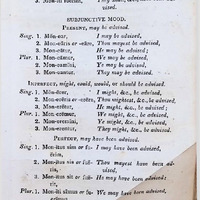

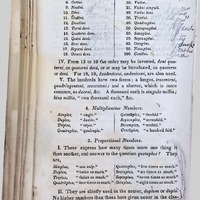
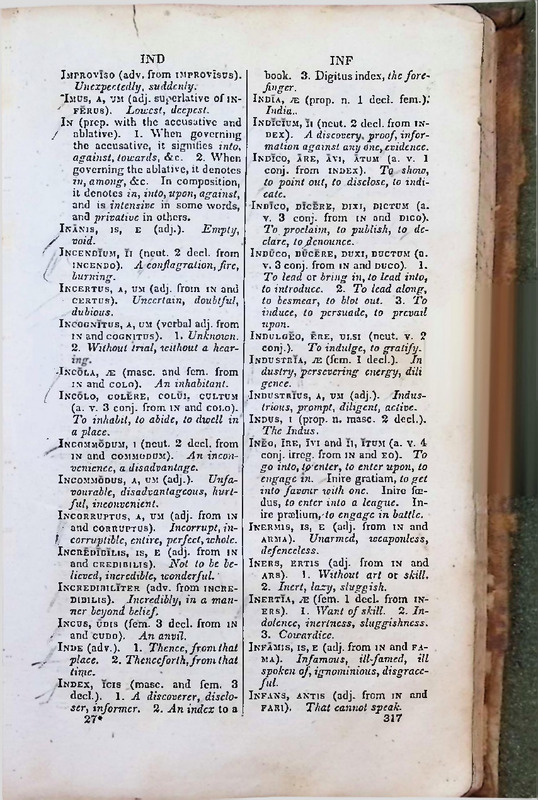
Found all throughout the dictionary in the second half of the text are slashes next to the entries; not every entry has a given slash made next to it, but there are well over a hundred which vary in thickness and depth.[30] The reason for these marks is once again unclear. It is possible these were marked off during certain grammatical exercises—such as extensive declining of nouns and conjugating verbs according to their tenses—or were marked off when encountered during other exercises or readings. The binding of the book itself has seemingly broken at the transition from grammar to dictionary, indicating this text may have primarily been used more for its dictionary than for its grammatical content.
Understanding and deciphering these markings can be difficult, as each person approaches language learning based off the education which guides them and their own strengths and weaknesses when it comes to language acquisition. Some struggle with syntax but excel in declension, and some can’t understand the difference between the nominative and accusative case but verb tense nuance is an easy task. Yet deciphering these marks, while helpful and informative of the person who made them, nonetheless highlight the materiality of textbooks and the role they serve: textbooks function not merely as the rhetoric of instruction but also the physical space for practice, repetition, and education. The instructional possibilities of textbooks, and of First Latin Lessons especially, expand beyond the words printed to the spaces between margins and the ability to underline, bracket, and practice in the blank space.
The content of the text is clear: a comprehensive and extensive introduction to Latin grammar and syntax. The book is divided into sections, each focusing on aspects of grammar. After this, the latter half of the text is dedicated to a comprehensive Latin dictionary.
The cultural value of First Latin Lessons can be understood in the context of the role the classics played in Antebellum society. As stated prior, education in the classics signaled wealth and upper-class status to others, and First Latin Lessons only increased this cultural value by being a cutting-edge piece of scholarship and resource part of the revolutions undergoing in the field. Such a piece imparts upon the viewer, in the context of the Antebellum South, an ongoing participation in the gentlemanly culture and long-standing tradition of classical scholarship in American society.